Difference between revisions of "British Railways"
(Created page with "{{About|the specific corporate entity|an overview|History of rail transport in Great Britain}} {{Use British English|date=July 2015}} {{Infobox company | name = British Railwa...") |
(→See also) |
||
| Line 199: | Line 199: | ||
==Parody== | ==Parody== | ||
In 1989, the [[ITV (TV Network)|ITV]] Sketch Show ''[[Spitting Image]]'' made a parody of Hudson's ''British Rail'' advert on the plans of the [[Conservative]] [[British Government]] to privatise the railways featuring numerous of the show's puppets (including the show's portrayal of [[List of Prime Ministers of the United Kingdom|former Prime Minister]] [[Margaret Thatcher]]), numerous BR trains and landmarks and even a cardboard cutout of [[Thomas the Tank Engine]].<ref>[https://www.youtube.com/watch?v=VFcBRHC9MV0 "Britain's Railway (but not for long)"]</ref> | In 1989, the [[ITV (TV Network)|ITV]] Sketch Show ''[[Spitting Image]]'' made a parody of Hudson's ''British Rail'' advert on the plans of the [[Conservative]] [[British Government]] to privatise the railways featuring numerous of the show's puppets (including the show's portrayal of [[List of Prime Ministers of the United Kingdom|former Prime Minister]] [[Margaret Thatcher]]), numerous BR trains and landmarks and even a cardboard cutout of [[Thomas the Tank Engine]].<ref>[https://www.youtube.com/watch?v=VFcBRHC9MV0 "Britain's Railway (but not for long)"]</ref> | ||
| − | |||
| − | |||
| − | |||
| − | |||
| − | |||
| − | |||
| − | |||
| − | |||
| − | |||
| − | |||
| − | |||
| − | |||
| − | |||
| − | |||
| − | |||
| − | |||
| − | |||
| − | |||
| − | |||
| − | |||
| − | |||
| − | |||
| − | |||
| − | |||
| − | |||
| − | |||
| − | |||
| − | |||
| − | |||
| − | |||
| − | |||
== References == | == References == | ||
Revision as of 09:32, 21 October 2015
| British Railways British Rail | |||
| File:24.07.84 Carlisle 85037 (5988267901).jpg | |||
| Location | |||
| London, United Kingdom | |||
| Industry | |||
| Land and sea transport | |||
| Defunct | |||
| 2001 | |||
| Fate | |||
| Privatised | |||
| Successor | |||
| Railtrack | |||
British Railways (BR), which from 1965 traded as British Rail, was the operator of most of the rail transport in Great Britain between 1948 and 1997. It was formed from the nationalisation of the "Big Four" British railway companies and lasted until the gradual privatisation of British Rail, in stages between 1994 and 1997. Originally a trading brand of the Railway Executive of the British Transport Commission, it became an independent statutory corporation in 1962: the British Railways Board.
The period of nationalisation saw sweeping changes in the national railway network. A process of dieselisation and electrification took place, and in 1968 steam locomotion had been entirely replaced by diesel and electric traction, except for one narrow-gauge tourist line. Passengers replaced freight as the main source of business, and one third of the network was closed by the Beeching Axe of the 1960s.
On privatisation, responsibility for track, signalling and stations was transferred to Railtrack and that for trains to the train operating companies.
The British Rail "double arrow" logo is formed of two interlocked arrows showing the direction of travel on a double track railway and was nicknamed "the arrow of indecision".<ref>Shannon, Paul. "Blue Diesel Days". Ian Allan Publishing. Retrieved 2008-11-16. Template:Dead link</ref> It is now employed as a generic symbol on street signs in Great Britain denoting railway stations, and as part of the Association of Train Operating Companies' jointly-managed National Rail brand is still being printed on railway tickets.<ref>Her Majesty's Government (2002). "The Traffic Signs Regulations and General Directions 2002 (SI 2002:3113)". Retrieved 2009-03-27.</ref>
Contents
History
Nationalisation in 1948

The rail transport system in Great Britain developed during the 19th century. After the grouping of 1923 under the Railways Act 1921 there were four large railway companies, each dominating its own geographic area: the Great Western Railway (GWR), the London, Midland and Scottish Railway (LMS), the London and North Eastern Railway (LNER) and the Southern Railway (SR). During World War I the railways were under state control, which continued until 1921. Complete nationalisation had been considered, and the Railways Act 1921<ref>Template:Cite hansard</ref> is sometimes considered as a precursor to that, but the concept was rejected; nationalisation was subsequently carried out after World War II, under the Transport Act 1947. This Act made provision for the nationalisation of the network, as part of a policy of nationalising public services by Clement Attlee's Labour Government. British Railways came into existence as the business name of the Railway Executive of the British Transport Commission (BTC) on 1 January 1948 when it took over the assets of the Big Four.<ref>Her Majesty's Government (1947). "Transport Act 1947". The Railways Archive. (originally published by Her Majesty's Stationery Office). Retrieved 2006-11-25.</ref>
There were also joint railways between the big four and a few light railways to consider (see list of constituents of British Railways). Excluded from nationalisation were industrial lines like the Oxfordshire Ironstone Railway. The London Underground — publicly owned since 1933 — was also nationalised, becoming the London Transport Executive of the British Transport Commission. The Bicester Military Railway was already run by the government. The electric Liverpool Overhead Railway was also excluded from nationalisation.
The Railway Executive was conscious that some lines on the (then very dense) network were unprofitable and hard to justify socially, and a programme of closures began almost immediately after nationalisation. However, the general financial position of BR became gradually poorer, until an operating loss was recorded in 1955. The Executive itself had been abolished in 1953 by the Conservative government, and control of BR transferred directly to the parent Commission. Other changes to the British Transport Commission at the same time included the return of road haulage to the private sector.
Regions
British Railways was divided into regions. Initially based on the areas the former Big Four operated in, however several lines were transferred between regions over the years; Notably, this included the former Great Central lines from the Eastern Region to the London Midland Region, and the West of England Main Line from the Southern Region to Western Region
- Southern Region of British Railways; Former Southern Railway lines.
- Western Region of British Railways; Former Great Western Railway lines.
- London Midland Region of British Railways Former London Midland and Scottish Railway lines in England.
- Eastern Region of British Railways Former London and North Eastern Railway lines south of York.
- North Eastern Region of British Railways Former London and North Eastern Railway lines in England north of York.
- Scottish Region of British Railways All lines, regardless of original company, in Scotland.
The North Eastern Region was merged with the Eastern Region in 1967. In the 1980s, the regions were abolished and replaced by "business sectors", a process known as sectorisation.
The Anglia Region was created in late 1987, its first General Manager being John Edmonds, who began his appointment on 19 October 1987. Full separation from the Eastern Region – apart from engineering design needs – occurred on 29 April 1988. It handled the services from Fenchurch Street and Liverpool Street, its western boundary being: Hertford East; Meldreth; and Whittlesea.<ref>Slater, John, ed. (December 1987). "Anglia Region created". Railway Magazine. Cheam: Prospect Magazines. 133 (1040): 758. ISSN 0033-8923.</ref><ref>Slater, John, ed. (July 1988). "Anglia takes over". Railway Magazine. Cheam: Prospect Magazines. 134 (1047): 426. ISSN 0033-8923.</ref>
1955 Modernisation Plan
The report latterly known as the "Modernisation Plan"<ref>British Transport Commission (1954). "Modernisation and Re-Equipment of British Rail". The Railways Archive. (Originally published by the British Transport Commission). Retrieved 2006-11-25.</ref> was published in January 1955. It was intended to bring the railway system into the 20th century. A government White Paper produced in 1956 stated that modernisation would help eliminate BR's financial deficit by 1962, but the figures in both this and the original plan were produced for political reasons and not based on detailed analysis.<ref name="last trains">Loft, Charles (2013) Last Trains - Dr Beeching and the Death of Rural England ISBN 9781849545006</ref> The aim was to increase speed, reliability, safety, and line capacity through a series of measures that would make services more attractive to passengers and freight operators, thus recovering traffic lost to the roads. Important areas included:
- Electrification of principal main lines, in the Eastern Region, Kent, Birmingham Liverpool/Manchester and Central Scotland
- Large-scale dieselisation to replace steam locomotives
- New passenger and freight rolling stock
- Resignalling and track renewals
- Modern marshalling yards
- The closure of an unspecified, but relatively small, number of lines
The government appeared to endorse the 1955 programme (costing £1.2 billion), but did so largely for political reasons.<ref name="last trains"/> This included the withdrawal of steam traction and its replacement by diesel (and some electric) locomotives. Not all the modernisations would be effective at reducing costs. The dieselisation program gave contracts primarily to British suppliers, who had limited experience of diesel locomotive manufacture, and rushed commissioning based on an expectation of rapid electrification resulted in numbers of locomotives with poor designs, and a lack of standardisation.<ref name="b4873">Terence Richard Gourvish; N. Blake (1986). British Railways, 1948-73: a business history. Cambridge University Press. pp. 286–288.</ref> At the same time containerised freight was being developed.<ref name="b4873"/> The marshalling yard building programme was a failure; being based on a belief in the continued viability of wagon load traffic in the face of increasingly effective road competition, and lacking effective forward planning or realistic assessments of future freight.<ref name="b4873">Terence Richard Gourvish; N. Blake (1986). British Railways, 1948-73: a business history. Cambridge University Press. pp. 288–290.</ref>
The Beeching report
During the late 1950s, railway finances continued to worsen, whilst passenger numbers grew after restoring many services reduced during the war, and in 1959 the government stepped in, limiting the amount the BTC could spend without ministerial authority. A White Paper proposing reorganisation was published in the following year, and a new structure was brought into effect by the Transport Act 1962.<ref>Her Majesty's Government (1962). "Transport Act 1962". The Railways Archive. (originally published by Her Majesty's Stationery Office). Retrieved 2006-11-25.</ref> This abolished the Commission and replaced it by a number of separate Boards. These included a British Railways Board, which took over on 1 January 1963.
Following semi-secret discussions on railway finances by the government-appointed Stedeford Committee in 1961, one of its members, Dr Richard Beeching, was offered the post of chairing the BTC while it lasted, and then becoming the first Chairman of the British Railways Board.<ref>"Back to Beeching", BBC Radio 4, 27 February 2010</ref>
A major traffic census in April 1961, which lasted one week, was used in the compilation of a report on the future of the network. This report—The Reshaping of British Railways—was published by the BRB in March 1963.<ref>British Transport Commission (1963). "The Reshaping of British Railways - Part 1: Report". The Railways Archive. (originally published by Her Majesty's Stationery Office). Retrieved 2006-11-25.</ref><ref>British Transport Commission (1963). "The Reshaping of British Railways—Part 2: Maps". The Railways Archive. (originally published by Her Majesty's Stationery Office). Retrieved 2006-11-25.</ref> The proposals, which became known as the "Beeching Axe", were dramatic. A third of all passenger services and more than 4,000 of the 7,000 stations would close. Beeching, who is thought to have been the author of most of the report, set out some dire figures. One third of the network was carrying just 1% of the traffic. Of the 18,000 passenger coaches, 6,000 were said to be used only 18 times a year or less. Although maintaining them cost between £3m and £4m a year, they earned only about £0.5m.<ref>Richard Beeching "The Reshaping of British Railways",p.15</ref>
Most of the closures were carried out between 1963 and 1970 (including some which were not listed in the report) while other suggested closures were not carried out. The closures were heavily criticised at the time,<ref>"The Economics and Social Aspects of the Beeching Plan"—Lord Stoneham, House of Lords, 1963</ref> and continue to be controversial.<ref>"Can Beeching be undone?". 2009.</ref> A small number of stations and lines closed under the Beeching programme have been reopened, with further reopenings proposed.<ref>"Move to reinstate lost rail lines", BBC, 15 June 2009</ref>
A second Beeching report, "The Development of the Major Trunk Routes", followed in 1965.<ref>"The Development Of The Major Railway Trunk Routes", The Railways Archive, British Railways Board, February 1965</ref> This did not recommend closures as such, but outlined a "network for development". The fate of the rest of the network was not discussed in the report.
Post-Beeching
The basis for calculating passenger fares changed in 1964. In future, fares on some routes—such as rural, holiday and commuter services—would be set at a higher level than on other routes; previously, fares had been calculated using a simple rate for the distance travelled, which at the time was 3d per mile second class, and 4½d per mile first class<ref>Cooke, B.W.C., ed. (July 1964). "Notes and News: New fares structure". Railway Magazine. Westminster: Tothill Press. 110 (759): 592.</ref> (equivalent to £Template:Inflation and £Template:Inflation respectively, in 2026Template:Inflation-fn).
Passenger levels decreased steadily from 1962 to the late 1970s,<ref>The UK Department for Transport (DfT), specifically Table 6.1 from Transport Statistics Great Britain 2006 (4MB PDF file)</ref> but experienced a renaissance with the introduction of the high-speed InterCity 125 trains in the late 1970s and early 1980s.<ref name="BRMP">Marsden, Colin J. (1983). British Rail 1983 Motive Power: Combined Volume. London: Ian Allen. ISBN 0-7110-1284-9.</ref> Network improvements included completing electrification of the Great Eastern Main Line from London to Norwich between 1976 and 1986 and the East Coast Main Line from London to Edinburgh between 1985 and 1990. A main line route closure during this period of relative network stability was the 1500V DC-electrified Woodhead Line between Manchester and Sheffield: passenger service ceased in 1970 and goods in 1981.
The 1980s and 1990s saw the closure of a number of railways which had survived the Beeching Axe a generation earlier, but which had seen passenger services withdrawn. This included the bulk of the Chester and Connah's Quay Railway in 1992, the Brierley Hill to Walsall section of the South Staffordshire Line in 1993, while the Birmingham to Wolverhampton section of the Great Western Railway was closed in three phases between 1972 and 1992.
A further British Rail report, from a committee chaired by Sir David Serpell, was published in 1983. The Serpell Report made no recommendations as such, but did set out various options for the network including, at their most extreme, a skeletal system of less than 2000 route km. This report was not welcomed, and the government decided to quietly leave it on the shelf. Meanwhile, BR was gradually re-organised, with the regional structure finally being abolished and replaced with business-led sectors. This process, known as "sectorisation", led to far greater customer focus, but was cut short in 1994 with the splitting up of BR for privatisation.
Upon sectorisation in 1982, three passenger sectors were created: InterCity, operating principal express services; London & South East (renamed Network SouthEast in 1986) operating commuter services in the London area; and Provincial (renamed Regional Railways in 1989) responsible for all other passenger services.<ref name="Thomas"/> In the metropolitan counties local services were managed by the Passenger Transport Executives. Provincial was the most subsidised (per passenger km) of the three sectors; upon formation, its costs were four times its revenue.<ref name="Thomas">Thomas, David St John; Whitehouse, Patrick (1990). BR in the Eighties. Newton Abbot: David & Charles. ISBN 0-7153-9854-7.</ref>
Because British Railways was such a large operation, running not just railways but also ferries, steamships and hotels, it has been considered difficult to analyse the effects of nationalization.<ref>Boocokc, Colin. Spotlight on BR: British Railways 1948-1998 Success or Disaster?. ISBN 9780906899984.</ref> During the 1980s British Rail ran the Rail Riders membership club aimed at 5–15 year olds.
Branding
Following nationalisation in 1948, British Railways began to adapt the corporate liveries on the rolling stock it had inherited from its predecessor railway companies. Initially, a GWR-style Brunswick green was used on passenger locomotives, and LNWR-style lined black for mixed-traffic locomotives, but later green was more widely adopted.<ref>Brian Haresnape Railway Liveries. BR Steam 1948-1968</ref><ref name="FOOTNOTEHeightCresswell1979">Height & Cresswell 1979.</ref>
Development of a corporate identity for the organisation was hampered by the competing ambitions of the British Transport Commission and the Railway Executive. The Executive attempted to introduce a modern, curved logo which could also serve as the standard for station signage totems. Due to its similarity to a hot dog, it became known as the "flying sausage". BR eventually adopted the common branding of the BTC as its first corporate logo, an Art Deco-style motif of a lion astride a spoked wheel, designed for the BTC by Cecil Thomas; on the bar overlaid across the wheel, the BTC's name was replaced with the words "British Railways". This logo, nicknamed the "Cycling Lion", was applied from 1948–1956 to the sides of locomotives, while the sausage logo was adopted for station signs across Great Britain, each coloured according to the appropriate BR region.<ref name="FOOTNOTEJackson2013">Jackson 2013.</ref>
In 1956, the BTC was granted a heraldic achievement by the College of Arms and the Lord Lyon, and then BTC chairman Brian Robertson wanted a grander logo for the railways. BR's second corporate logo (1956–1965), designed in consultation with Charles Franklyn, adapted the original, depicting a rampant lion emerging from a heraldic crown and holding a spoked wheel, all enclosed in a roundel with the "British Railways" name displayed across a bar on either side. This emblem soon acquired the nickname of the "Ferret and Dartboard". A variant of the logo with the name in a circle was also used on locomotives.<ref name="FOOTNOTEJackson2013">Jackson 2013.</ref>
The zeal for modernisation in the Beeching era drove the next rebranding exercise, and BR management wished to divest the organisation of anachronistic, herdaldic motifs and develop a corporate identity to rival that of London Transport. BR's design panel set up a working party led by Milner Gray of the Design Research Unit. They drew up a Corporate Identity Manual which established a coherent brand and design standard for the whole organisation, specifying Rail Blue and pearl grey as the standard colour scheme for all rolling stock; Rail Alphabet as the standard corporate typeface, designed by Jock Kinneir and Margaret Calvert; and introducing the now-iconic Corporate Identity Symbol of the "Double Arrow" logo. Designed by Gerald Barney (also of the DRU), this arrow device was formed of two interlocked arrows across two parallel lines, symbolising a double track railway. It was likened to a bolt of lightning or barbed wire, and also acquired a nickname: "the arrow of indecision". The new BR corporate identity and Double Arrow were rolled out in 1965, and the brand name of the organisation was truncated to "British Rail".<ref name="FOOTNOTEJackson2013">Jackson 2013.</ref><ref name="FOOTNOTEHeightCresswell1979">Height & Cresswell 1979.</ref>
The uniformity of BR branding continued until the process of sectorisation was introduced in the 1980s. Certain BR operations such as Inter-City, Network SouthEast or Railfreight began to adopt their own identities, introducing logos and colour schemes which were essentially variants of the British Rail brand. Eventually, as sectorisation developed into a prelude to privatisation, the unified British Rail brand disappeared, with the notable exception of the Double Arrow symbol, which has survived to this day and serves as a generic trademark to denote railway services across Great Britain.<ref name="FOOTNOTEJackson2013">Jackson 2013.</ref>
- The first emblem of British Railways (6870888583).jpg
The first emblem of British Railways, the "Cycling Lion" (1950-1956)
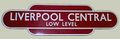
Liverpool Central station sign using the "Flying Sausage" format
- British Railways 1956 logotype.jpg
The "Ferret & Dartboard" crest (1956–1965)
- British Railways 1956 logotype.png
A circular variant of the 1956 logo
- Good old British Rail logo (7417051300).jpg
The British Rail "Double Arrow" (1965)

Finances
Template:EditorialTemplate:IncoherentTemplate:Spacing Despite being nationalised in 1947 "as one of the ‘commanding heights’ of the economy",<ref>http://www.rail.co.uk/british-railway-history/british-railways/</ref> British Rail was not profitable for many years, probably most or all<ref>http://www.rail.co.uk/british-railway-history/</ref> with narrow income (according to different sources).<ref>British Railways 1948-73: A Business History, T. R. Gourvish</ref> In fact there were examples (even during the 1990s), according to newspapers, that public subsidy was counted as profit.<ref>http://www.independent.co.uk/news/british-rail-profit-figure-masks-doubling-of-subsidy-1589866.html</ref> As early as 1961, British Railways were losing £300,000 every day.<ref>http://blogs.spectator.co.uk/coffeehouse/2013/03/fifty-years-on-from-beeching-and-britains-railways-are-better-than-ever/</ref> It was thought that most of the nationalised railways, excluding some freight services, may, like any other privatised business with no income in the UK, cease to operate .<ref>http://cs.trains.com/trn/f/111/t/225359.aspx</ref> In fact the nationalisation saved private business, helping investors who often achieved income in previous decades (e.g. 1870-1912).<ref>"HOW GOOD WAS THE PROFITABILITY OF BRITISH RAILWAYS, 1870-1912?, BRIAN MITCHELL, DAVID CHAMBERS, & NICHOLAS CRAFTS"</ref> Other usual discussion arguments cites the role of British rail as a sole transport option for many rural areas. However, after "The Beeching Report" many connections to towns and villages were cut, (whilst car ownership was growing) and public transport was nothing or based on coaches.<ref>http://www.jrtr.net/jrtr09/f12_wek.html</ref> Despite increase in cars and also road fuel prices since the 1990s, British Rail remained unprofitable.<ref>http://www.telegraph.co.uk/motoring/news/9946655/Petrol-sales-plummet-to-lowest-level-since-1990.html</ref>
British Rail Investment
Template:Incomplete British Rail rebuilt London Liverpool Street in 1991, opened by H.M. Queen Elizabeth II. British Rail constructed a new station at Stansted Airport in 1991. British Rail re-opened the line to Aberdare in 1988 and the Maesteg Line in 1992. Electrified the line to King's Lynn in 1992. In 1988, an Advert for British Rail directed by Hugh Hudson was made called 'Britain's Railway' and shows some of the most iconic railway structures in Britain including the Forth Rail Bridge, Royal Albert Bridge, Glenfinnan Viaduct and London Paddington station.<ref>"Britain's Railway Advert"</ref>
Privatisation of British Rail
Between 1994 and 1997, British Rail was privatised.<ref>Her Majesty's Government (1903). "Railways Act 1993". The Railways Archive. (originally published by Her Majesty's Stationery Office). Retrieved 2006-11-26.
</ref> Ownership of the track and infrastructure passed to Railtrack on 1 April 1994; afterwards passenger operations were franchised to individual private-sector operators (originally there were 25 franchises); and the freight services sold outright (six companies were set up, but five of these were sold to the same buyer).<ref>"EWS Railway—Company History". Archived from the original on 2006-09-30. Retrieved 2006-11-26.
</ref>
The Waterloo and City line had been part of BR Network SouthEast and was not included in the privatisation. It was transferred to London Underground in December 1994. The remaining obligations of British Rail not mentioned above were transferred to BRB (Residuary) Ltd.
At the time privatisation of British Rail was proposed by the Conservative government in 1992 many bodies opposed the process, including the Labour party and the rail unions. The Labour party initially proposed to reverse the nationalisation process;<ref>- Macintyre, Donald (10 January 1995), "Blair soft-pedals over reversing BR privatisation", www.independent.co.uk</ref> however the New Labour manifesto of 1997 did not propose to reverse privatisation but opposed Conservative plans for privatisation of the London Underground.<ref>"Labour Party Manifesto", www.labour-party.org.uk (website unaffiliated with the official Labour Party), Railways, 1997</ref>
Rail unions have been historically opposed to the privatisation; however in 2004 ASLEF general secretary, Lew Adams stated on a radio phone-in program: "All the time it was in the public sector, all we got were cuts, cuts, cuts. And today there are more members in the trade union, more train drivers, and more trains running. The reality is that it worked, we’ve protected jobs, and we got more jobs."<ref>TRANSCRIPT FROM THE BILL GOOD SHOW, CKNW RADIO, VANCOUVER - Interview with Lew Adams, Board Member, Strategic Rail Authority, UK (PDF) (transcript), Canadian Council for Public-Private Partnerships website, 26 November 2004</ref>
Accidents and incidents
Network
The former BR network, with the trunk routes of the West Coast Main Line, East Coast Main Line, Great Western Main Line and Midland Main Line, remains mostly unchanged since privatisation. Several lines have reopened and more are proposed, particularly in Scotland and Wales where the control of railway passenger services is devolved from central government. However, in England passenger trains have returned to Mansfield, Corby, Chandlers Ford, the reopened line to Aylesbury Vale Parkway and there are numerous other proposals to restore services, such as Oxford-Milton Keynes/Aylesbury, Lewes-Uckfield, Bristol-Portishead and Plymouth-Tavistock. In London, Tyne and Wear, Greater Manchester, the West Midlands and Nottingham urban light-rail systems have taken over the routes of some former BR routes.
In Wales, the Welsh Assembly Government successfully supported the re-opening to passenger services, of the Vale of Glamorgan Line between Barry and Bridgend in 2005. In 2008 the Ebbw Valley Railway reopened between Ebbw Vale Parkway and Cardiff, with services to Newport scheduled to commence by 2011. (The Barry-Bridgend route was included in the closures proposed in the Beeching report of March 1963 and its services were duly withdrawn in June 1964, but Ebbw Vale had already been closed to passengers before the report was published.)
In Scotland the Scottish Government have reinstated the lines between Hamilton and Larkhall, Stirling and Alloa, and Airdrie to Bathgate. The biggest line reinstatement project was the rebuilding of part of the former Waverley Route from Edinburgh to Carlisle as the Borders Railway.<ref>"Waverley Rail Project route".</ref>
Preserved Railway Lines
On its creation British Railways included the narrow gauge Vale of Rheidol Railway in Wales. Although built as a working railway, this line was by that time already principally a tourist asset. British Rail continued to operate the line, using steam locomotives, well beyond the withdrawal of standard gauge steam. The line's three steam locomotives became the only steam engines to receive TOPS serial numbers, and the only steam engines to be painted in BR Rail Blue livery, and to carry the double arrow logo. The Vale of Rheidol Railway was privatised in 1989, and continues to operate as a private heritage railway.
Other preserved lines, or Heritage railways, have reopened some lines previously closed by British Rail. These range from picturesque rural branch lines like the Keighley and Worth Valley Railway to sections of mainline such as the Great Central Railway. Many have links to the National Rail network, both station interchange, for instance the Severn Valley Railway between Kidderminster and Kidderminster Town, and physical rail connections like the Watercress Line at Alton.
Although most are operated solely as leisure amenities some also provide educational resources, and a few have ambitions to restore commercial services over routes abandoned by the nationalised industry.
Ships
British Railways operated a number of ships from its formation in 1948 on a variety of routes. Many ships were acquired on nationalisation, and others were built for operation by British Railways or its later subsidiary, Sealink. Those ships capable of carrying rail vehicles were classed under TOPS as Class 99.
Seaspeed
Hovercraft services run by Seaspeed.
Successor companies
Under the process of British Rail's privatisation, operations were split into more than 100 companies. The ownership and operation of the infrastructure of the railway system was taken over by Railtrack. The Telecomms infrastructure and British Rail Telecommunications was sold to Racal, which in turn was sold to Global Crossing and merged with Thales Group. The rolling stock was transferred to three private ROSCOs (rolling stock companies). Passenger services were divided into 25 operating companies, which were let on a franchise basis for a set number of years, whilst goods services were sold off completely. Dozens of smaller engineering and maintenance companies were also created and sold off.
British Rail's passenger services came to an end upon the franchising of ScotRail; the final train that the company operated was a Railfreight Distribution goods train in autumn 1997. The British Railways Board continued in existence as a corporation until early 2001, when it was replaced with the Strategic Rail Authority.
Since privatisation, the structure of the rail industry and number of companies has changed a number of times as franchises have been relet and the areas covered by franchises restructured. Franchise-based companies that took over passenger rail services include:
- Midland Mainline—superseded in 2007 by East Midlands Trains
- Great North Eastern Railway—superseded in 2007 by National Express East Coast, which has since been brought back full circle into public ownership with the creation of the new government controlled East Coast operator. The East Coast franchise was transferred to Virgin Trains East Coast on 1 March 2015.
- Virgin Trains (West Coast)
- Virgin CrossCountry—superseded in 2007 by CrossCountry
- ScotRail operated by National Express—superseded in 2004 by First ScotRail. Control of the franchise has since passed to Abellio ScotRail
- Great Western Trains—from 1998: Great Western Railway
- Wales & West—became Wessex Trains and Wales & Borders (including the Cardiff Railway Company services operated as Valley Lines) in 2001, after being split into two separate franchises, and now run by Great Western Railway and Arriva Trains Wales
- Arriva Trains Northern originally Northern Spirit, succeeded in 2004 by First TransPennine Express and Northern Rail
- First North Western originally North Western Trains, succeeded in 2004 by First TransPennine Express and Northern Rail
- Anglia Railways, Great Eastern (later First Great Eastern), and the West Anglia section of WAGN were all merged to become One later renamed National Express East Anglia, superseded in 2012 by Abellio Greater Anglia
- Thameslink and Great Northern Section of WAGN grouped together to form First Capital Connect as part of the Thameslink Great Northern Franchise.
- LTS later renamed c2c
- Connex South Eastern became South Eastern Trains, then Southeastern
- Connex South Central became South Central and later renamed Southern
- Merseyrail Electrics superseded by Arriva Trains Merseyside and now Merseyrail
- South West Trains
- Central Trains—divided in 2007 between London Midland, CrossCountry and East Midlands Trains
- London Underground for the short underground Waterloo & City line
- Silverlink Trains—divided in 2007 between London Overground and London Midland
Future
Since Privatisation, many Groups have campaigned for the Renationalisation of British Rail, most notably 'Bring Back British Rail'. Various interested parties also have views on the future shape of the privatised British railways.
The renationalisation of the railways of Britain continue to have popular support. A poll in 2012 showed 70% support for renationalisation.<ref>"70% want end to rail privatisation", www.globalrailnews.com, 13 Sep 2012</ref>
Due to rail franchises lasting sometimes over a decade, full renationalisation would take years unless compensation was paid to terminate contracts early. The former Green Party leader Caroline Lucas has submitted a Private Member's Bill calling for individual franchises, when they expire or when a company fails to meet its franchise conditions, to fall back into public ownership, this will avoid expensive compensation to the rail companies.
When the infrastructure owning company Railtrack ceased trading the Labour government set up a not for dividend company Network Rail to take over the duties rather than renationalise this part of the network. However On 1 September 2014, Network Rail was reclassified as a central government body, adding around £34 billion to public sector net debt. This reclassification had been requested by the Office for Budget Responsibility to comply with pan-European accounting standard ESA10.<ref>Budget (19 March 2014). "Budget 2014: fears of more austerity in spite of growth". Telegraph. Retrieved 20 May 2014.</ref>
Parody
In 1989, the ITV Sketch Show Spitting Image made a parody of Hudson's British Rail advert on the plans of the Conservative British Government to privatise the railways featuring numerous of the show's puppets (including the show's portrayal of former Prime Minister Margaret Thatcher), numerous BR trains and landmarks and even a cardboard cutout of Thomas the Tank Engine.<ref>"Britain's Railway (but not for long)"</ref>
References
- Jackson, Tanya (2013). "6: In Search of an Identity". British Railways: The Nation's Railway. Stroud: The History Press. ISBN 9780752497426. Retrieved 11 September 2015.CS1 maint: ref=harv (link)
- Height, Frank; Cresswell, Roy (1979). Design for Passenger Transport. Pergamon. p. 118. ISBN 9781483153094. Retrieved 11 September 2015.CS1 maint: ref=harv (link)
Further reading
- Brady, Robert A. (1950). Crisis in Britain. Plans and Achievements of the Labour Government. University of California Press., on nationalization 1945-50, pp 236–83
External links
| 40x40px | Wikimedia Commons has media related to British Railways and British Rail.Script error: No such module "Preview warning". |
Template:British Rail Template:National railway companies of Europe
- Pages with broken file links
- Pages with script errors
- Harv and Sfn no-target errors
- CS1 maint: ref=harv
- Commons category link is locally defined
- Use dmy dates from June 2011
- Articles with invalid date parameter in template
- British Rail
- Defunct railway companies of the United Kingdom
- Former nationalised industries of the United Kingdom
- Railway companies established in 1948
- 1948 establishments in the United Kingdom


